
Back to School Traffic Safety
Back-to-School Season Needs Extra Driving Caution
Kids are excited to be back at school and that excitement often comes with distraction and unpredictable movement like darting across a street, cutting between parked cars or not checking both ways before crossing. Combined with darker morning commutes and busy after-school pickup traffic, early fall is one of the higher-risk periods for young pedestrians. A little extra attention from drivers goes a long way toward keeping kids safe during the transition back into routine.
What Should Drivers Watch For in School Zones?
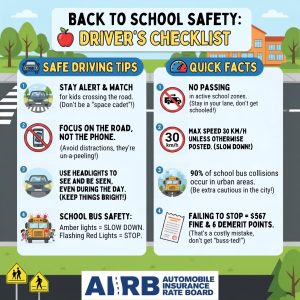
- Children crossing unpredictably. Stay alert for kids stepping into the road, especially near crosswalks and school entrances.
- Cyclists and walkers. Scan carefully rather than relying on peripheral awareness; distractions are the biggest risk factor.
- Low-light conditions. Turn on headlights during dark mornings and dim afternoons to improve visibility, both to see and to be seen.
What Are Alberta’s School Zone Speed and Passing Rules?
The speed limit in both urban and rural school zones is 30 km/h, unless a different limit is posted. Drivers are also not permitted to pass or attempt to pass another vehicle travelling in the same direction while inside an active school zone. These rules apply specifically when the school zone is in effect, typically during school arrival and dismissal hours.
What Do Flashing School Bus Lights Mean?
- Flashing amber lights mean a school bus is slowing down and preparing to stop. This is your signal to slow down and be ready to stop.
- Flashing red lights mean the bus has stopped to let children on or off. Drivers approaching from either direction, front or behind, must stop.
- Stay stopped until the red lights stop flashing and keep watching for children before continuing, since kids may still be crossing near the bus.
How Does Speeding in a School Zone Affect Your Insurance?
Beyond the ticket itself, speeding in a school or playground zone comes with a cost that shows up long after the fine is paid. In Alberta, this offence is classified as a major conviction, the same category as other serious safety violations and they carry the steepest insurance surcharges of any ticket type. One major conviction can increase your auto insurance premium by roughly 31% and that increase typically stays on your insurance record for three years from the conviction date, unlike the two years demerit points remain on your licence.
Alberta’s speeding fines are also doubled in school and playground zones during posted hours, on top of the insurance impact, which means a school zone speeding ticket costs more upfront and costs more down the road. Given how quickly children can step into the road near a school, slowing down isn’t just the safer choice, it’s the one that protects your wallet too.
What Happens If a Driver Doesn’t Stop for a School Bus?
Failing to stop for a school bus displaying flashing red lights carries a penalty of $567 and six demerit points in Alberta.
Are School Bus Collisions More Common in Certain Areas?
Yes. About 90% of collisions involving school buses occur in urban areas, which lines up with where most students walk, bike, or wait near roadways during pickup and drop-off.
How Can Parents and Educators Help?
Drivers aren’t the only piece of the puzzle. Parents, guardians and educators can reinforce road safety by regularly reviewing the basics with kids throughout the school year like looking both ways, using crosswalks, making eye contact with drivers before crossing and staying visible in low-light conditions.
Summary
As students head back to class, Alberta drivers are reminded to slow down and stay alert around school zones, crosswalks and school buses. The speed limit in both urban and rural school zones is 30 km/h unless otherwise posted, passing another vehicle in an active school zone is not allowed and drivers must stop for a school bus with flashing red lights, from either direction, except on a divided highway. Failing to stop for a school bus carries a $567 fine and six demerit points. Speeding in a school zone also carries a major conviction, which can raise your auto insurance premium by roughly 31%.
Frequently Asked Questions
What is the speed limit in an Alberta school zone? 30 km/h in both urban and rural school zones, unless a different limit is posted.
Can I pass another car in a school zone? No. Passing or attempting to pass another vehicle travelling in the same direction is not allowed while a school zone is in effect.
What do flashing amber lights on a school bus mean? The bus is slowing down and preparing to stop, so the drivers should slow down and prepare to stop as well.
Do I have to stop for a school bus with flashing red lights if I’m driving in the opposite direction? Yes, unless you’re on the opposite side of a physically divided highway, in which case you’re not required to stop.
What’s the penalty for not stopping for a school bus in Alberta? A $567 fine and six demerit points.
When can I start driving again after stopping for a school bus? Only once the flashing red lights have stopped and after checking carefully for any children still near the bus or crossing the road.
Where do most school bus-related collisions happen? About 90% occur in urban areas.
Does speeding in a school zone affect my car insurance? Yes. Speeding in a school or playground zone is classified as a major conviction in Alberta, and a single major conviction can increase your insurance premium by roughly 31%, typically for up to three years.
Are speeding fines higher in school zones? Yes. Alberta doubles standard speeding fines in school zones, playground zones, construction zones, and near emergency responders when the zone is in effect.